

When Puan Suzana was diagnosed with breast cancer, she expected chemotherapy to be the toughest part of her journey.
She never imagined one of her greatest daily battles would simply be eating.
“Some days, after going through chemotherapy, I didn’t feel like eating at all. Even swallowing became difficult,” she recalled.
As treatment progressed, Puan Suzana’s appetite dwindled and her weight began to fall. Every meal became a negotiation between what her body needed and what it could tolerate. When her dietitian introduced Valens Onthera+, a specialised immunonutrition formula, she saw it as a supportive part of her cancer care journey.
“I call it (Valens Onthera+) my “Susu Coklat” and I take it on days I find it difficult to eat or swallow,” she said with a smile.
“On days especially after treatment, when I feel extremely weak and tired, taking “SusuCoklat” helps me feel a little stronger. My dietitian said it’s good for me as part of my diet because it provides the nutrition my body needs. I do feel a little more energised when I have it, especiallyaftertreatment.”
Puan Suzana’s story is one shared by countless cancer patients across Malaysia.
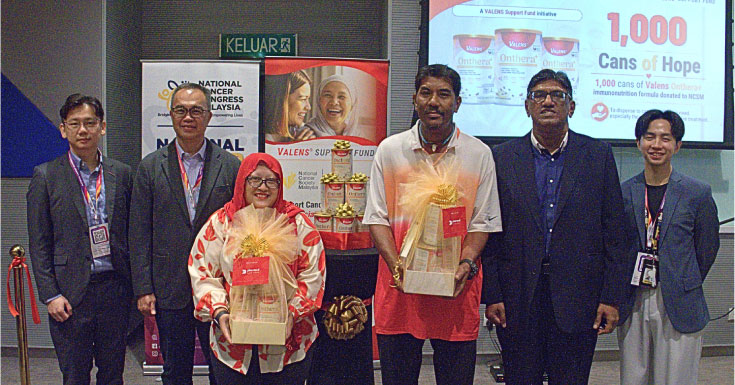
Main image: At the launch of the Valens Onthera+ “1,000 Cans of Hope” initiative, bringing together key representatives from Pharm-D Health Science Berhad and the National Cancer Society Malaysia (NCSM). From left to right: Lim Kean Ping, CEO of Pharm-D Sdn Bhd; WongChin Cheang, Group Managing Director of Pharm-D Health Science Berhad; cancer patients Aini Suzana Abu Kassim and Muzammil Ramli; Kol. Bersekutu (PA) Assoc Prof Dr Murallitharan Munisamy (Dr Murali), Managing Director of NCSM; and Jefferson Ng Khai Qiang, Clinical Psychologist and Assistant Manager of Psychosocial Support Department at NCSM.
The Hidden Burden Beyond Cancer Treatment
While public conversations around cancer often centre on diagnosis, surgery and treatment, an equally significant challenge frequently remains invisible: the struggle to maintain optimal nutrition.
Studies estimate that between 40% and 80% of cancer patients experience malnutrition during their treatment journey, making it one of the most common yet overlooked complications of cancer care (1, 2, 3). Yet despite its prevalence, nutrition often receives far less attention than other aspects of cancer care, even though poor nutritional status may affect patients’ strength, recovery and overall quality of life.
Today, this often-overlooked challenge is receiving renewed attention in Malaysia following the publication of a pioneering local clinical study on the use of immunonutrition as nutritional support in cancer care.
New Malaysian Evidence on Perioperative Immunonutrition for Cancer
Backed by a growing body of clinical evidence, immunonutrition is recommended in international clinical nutrition guidelines for selected patients undergoing major surgery, particularly within Enhanced Recovery After Surgery (ERAS) programmes (4,5,6).
Contributing to this growing evidence base is a Malaysian clinical study published in peer-reviewed journal Supportive Care in Cancer. This open-label randomised controlled trial enrolled 110 gynaecological cancer patients undergoing surgery at Institut Kanser Negara within an ERAS programme, which measures comparison of perioperative immunonutrition intervention against standard nutritional care.
The study found that cancer patients receiving immunonutrition experienced significantlybetterclinical outcomes than those receiving standard nutritional care. These included shorter hospitalstays, faster recovery of gastrointestinal function, improved wound healing, better preservationofnutritional and functional status, healthier inflammatory profiles, and notably, zerohospitalreadmissions within 30 days after surgery (7).
The immunonutrition intervention evaluated in the study was Valens Onthera+, a Malaysian-developed specialised immunonutrition formula.
Beyond validating clinical benefits, the study contributes robust Malaysian clinical evidence to highlight the role and importance of perioperative immunonutrition in cancer care, beyond data drawn largely from Western and East Asian populations.
Bridging the Gap to Evidence-Based Immunonutrition
While growing clinical evidence continues to reinforce the importance of nutrition in cancer care,many cancer patients in Malaysia still struggle to acquire the much-needed nutritional support.
To help bridge this gap, the Valens Onthera+ “1,000 Cans of Hope” initiative was launched at the Psychosocial Support Summit that was held in conjunction with National Cancer Congress Malaysia 2026. It builds on the VALENS® Support Fund, a cancer CSR programme jointly established by Pharm-D Health Science Berhad (Pharm-D HS) and the National Cancer Society Malaysia (NCSM) which was officially launched on World Cancer Day 2026 in the presence of Health Minister Datuk Seri Dr Dzulkefly Ahmad.
Under this initiative, 1,000 cans of Valens Onthera+ immunonutrition formula are provided to eligible cancer patients identified through NCSM via comprehensive nutritional assessments and consultation by NCSM’s clinical dietitians to determine individual nutritional needs and clinical suitability.
Making Nutrition an Integral Part of Cancer Care
Speaking at the launch, Wong Chin Cheang, Group Managing Director of Pharm-D Health Science Berhad, said the initiative represents a broader mission to establish nutrition as a core pillar of cancer care.
“When people hear the word “cancer”, they naturally think about chemotherapy, surgery and medicines. Yet, one of the hardest parts of treatment many patients face is simply finding the strength to eat. Nutrition is far more than an afterthought; it is an essential component of supportive cancer care.”
He continued:
“When we launched the VALENS® Support Fund on World Cancer Day earlier this year, we envisioned it more than a financial assistance programme. We want to spark a broader movement that recognises specialised nutrition as an integral part of comprehensive cancer care. The Valens Onthera+ “1,000 Cans of Hope” initiative turns that vision into action, in ensuring patients receive not only nutritional support, but also professional guidance from qualified dietitians who understand their unique nutritional needs throughout treatment.”
Kol. Bersekutu (PA) Assoc Prof Dr Murallitharan Munisamy, Managing Director of NCSM, added that nutritional challenges are among some of the most distressing, yet least visible aspects of the cancer journey.
“Cancer affects much more than the disease itself. Patients may struggle with eating, maintaining weight and preserving their strength while navigating the emotional and financial realities of treatment. By integrating professional nutritional assessment with accessibility to specialised immunonutrition, we hope to help patients focus on what matters most: their recovery and quality of life.”
“1,000 Cans of Hope” as a Start of a Broader Movement
While the initiative provides specialised immunonutrition to eligible patients, Pharm-DHS and NCSM believe its significance lies in encouraging a shift in how cancer care is understood in Malaysia, and to initiate a broader movement towards a more holistic cancer care.
Built on this shared vision, the VALENS® Support Fund extends beyond nutritional support through patient and caregiver education, community outreach initiatives and nutritional awareness programmes designed to empower patients and families throughout every stage of the cancer journey. The Valens Onthera+ “1,000 Cans of Hope” is one such initiative to reflect this commitment.
For cancer patient Puan Suzana, the support she received represented far more than a nutritional formula.
“It reminded me that being strong isn’t just about getting through treatment, but also about taking care of myself. Beyond giving me the help I need, this support brings hope and a constant reminder to never give up.”
- Ryan, A. M., Power, D. G., Daly, L., Cushen, S. J., Ní Bhuachalla, Ē., & Prado, C. M. (2016). Cancer-associated malnutrition, cachexia and sarcopenia. Proceedings of the Nutrition Society, 75(2), 199–211. https://doi.org/10.1017/S002966511500419X
- Muscaritoli, M., et al. (2017). Prevalence of malnutrition in patients at first medical oncology visit: thePreMiO study. Oncotarget, 8(45), 79884–79896. https://doi.org/10.18632/oncotarget.201683. Aaldriks, A. A., et al. (2013). Frailty and malnutrition predictive of mortality risk in older patientswithadvanced colorectal cancer. Journal of Geriatric Oncology, 4(3), 218–226. https://doi.org/10.1016/j.jgo.2013.04.001
- Weimann, A., et al. (2021). ESPEN practical guideline: Clinical nutrition in surgery. Clinical Nutrition, 40(7), 4745–4761. https://doi.org/10.1016/j.clnu.2021.03.031
- Arends, J., et al. (2017). ESPEN guidelines on nutrition in cancer patients. Clinical Nutrition, 36(1), 11–48. https://doi.org/10.1016/j.clnu.2016.07.015
- Liu, Y., et al. (2024). The application of immunonutrition in patients with cancer. Holist IntegOncol 3, 45. https://doi.org/10.1007/s44178-024-00112-w
- Ho, C.Y., Daud, Z.A.M., Mohd Yusof, B.N. et al. (2026). Perioperative immunonutrition interventionon postoperative outcomes among gynaecological cancer patients under enhanced recoveryaftersurgery setting. Support Care Cancer 34, 333. https://doi.org/10.1007/s00520-026-10557-6
