


Stroke can strike at any age, and in children, missed signs and delayed care can have lasting effects.
When most people picture a stroke, they picture an older adult, often someone living with high blood pressure, diabetes or high cholesterol, and not a child. It is not something most parents would ever expect to worry about. Yet stroke can happen at any age, from newborns right through to teenagers.
The Paediatric Protocols for Malaysian Hospitals, developed by the Ministry of Health and the Malaysian Paediatric Association, cites an estimated childhood stroke incidence of 2.5 to 13 cases per 100,000 children each year[1]. While uncommon compared with adult stroke, its rarity is part of the challenge, as sudden symptoms can easily be missed or mistaken for a more common childhood illness.
According to Dr Tan Jen Ern, Consultant Paediatrician and Paediatric Neurologist at Sunway Medical Centre Velocity (SMCV), paediatric stroke can occur at any age, and while Malaysia’s incidence has not been comprehensively recorded, Dr Tan sees around 1-2 cases a year in clinical practice. “Paediatric stroke is rare, but rarity does not mean it cannot happen.” The important message is to recognise sudden neurological changes and seek emergency assessment promptly,” says Dr Tan.
Spotting the Signs and Acting Fast
Part of what makes paediatric stroke difficult to identify is that children may not present the way adults do. “Unlike adults, children often cannot describe exactly what they are feeling, and many other childhood conditions can look like a stroke. Adding to that, a general lack of awareness among both parents and healthcare professionals can make paediatric stroke easily be overlooked,” explains Dr Tan.
Warning signs can also look different depending on the child’s age. In older children and teenagers, stroke can look much like it does in adults, with facial drooping, weakness on one side or difficulty speaking. In babies and toddlers, however, the signs can be far more subtle, such as seizures or difficulty feeding.
Because stroke is rarely expected in children, parents may wait to see if symptoms pass. However, stroke remains a time-sensitive emergency regardless of age. “Parents should note the time when the child was last known to be well, because the timing of symptoms can be important in determining emergency treatment options. Calling an ambulance allows the emergency system to help coordinate the appropriate destination and facilitate transfer to a facility with stroke expertise,” advises Dr Tan.
The nearest hospital is not always the one best equipped for an acute stroke. “Time is brain. If the facility cannot promptly provide the necessary brain and vascular imaging or specialist assessment, the child may need to be referred or transferred. That can mean additional time before the diagnosis is confirmed and before specialised treatment can be considered,” says Dr Tan.
Why Would a Child Have a Stroke?
Unlike adults, children who have a stroke usually do not have lifestyle-related risk factors. Paediatric stroke can instead be linked to heart disease, abnormalities of the blood vessels in the brain, blood disorders, infection or inflammation, trauma, and certain genetic or metabolic conditions. This means a child who appears completely healthy can still be affected. “In most cases, these children have an underlying condition that has yet to be identified. In my practice, the most common underlying cause is an abnormality of the brain’s blood vessels,” shares Dr Tan.
Finding that cause requires a thorough investigation, including blood tests, screening for blood-clotting disorders (thrombophilia) where needed, a heart tracing (ECG) and an ultrasound scan of the heart (echocardiogram), as well as a brain scan that also maps the blood vessels (MRI with MRA).
Initial treatment focuses on stabilising the child, controlling seizures and managing complications, with clot-preventing medications used depending on the cause. For selected children who meet strict criteria, a minimally invasive procedure to remove the clot from a blocked artery (endovascular thrombectomy) may be considered with the necessary expertise.
Identifying the cause also matters for the future, as Malaysia’s paediatric protocol notes that 12% to 20% of childhood arterial ischaemic strokes (strokes caused by a blocked artery) may recur[2]. “Recurrence risk is not the same for every child. An abnormality of the brain’s arteries carries a higher risk. Treating the underlying cause can reduce that risk, alongside close follow-up with paediatric neurology and other relevant specialists,” says Dr Tan.
The Effects Can Continue Long After the Emergency
For a child, stroke can affect far more than movement. A Malaysian study published in 2025 followed 76 children for at least two years after their stroke[3]. Around three in four recovered well enough to manage daily activities and showed good neurological recovery. Even so, their overall quality of life remained noticeably lower than that of healthy Malaysian children, especially among those who developed learning difficulties.
“A child may have a relatively good physical recovery but continue to experience difficulties with attention, processing speed, memory, learning, communication, emotional regulation, social participation or confidence. These can have a major effect on school, relationships and everyday life,” explains Dr Tan.
Some effects may only surface years later. Dr Tan notes that a young child may seem to be recovering very well at first, only for difficulties to become more apparent as they start school and face greater learning and developmental demands. This is why long-term follow-up matters, with rehabilitation forming a core part of care through physiotherapy, occupational therapy, speech and language therapy, neuropsychological assessment and educational support.
For Dr Tan, the single misconception parents most need to unlearn is that strokes only happen in adults. “If your child suddenly develops weakness on one side, an uneven face, difficulty speaking or an unexplained seizure, seek medical attention immediately. The goal is not only to treat the acute stroke, but to support the child’s development and quality of life as they grow.”
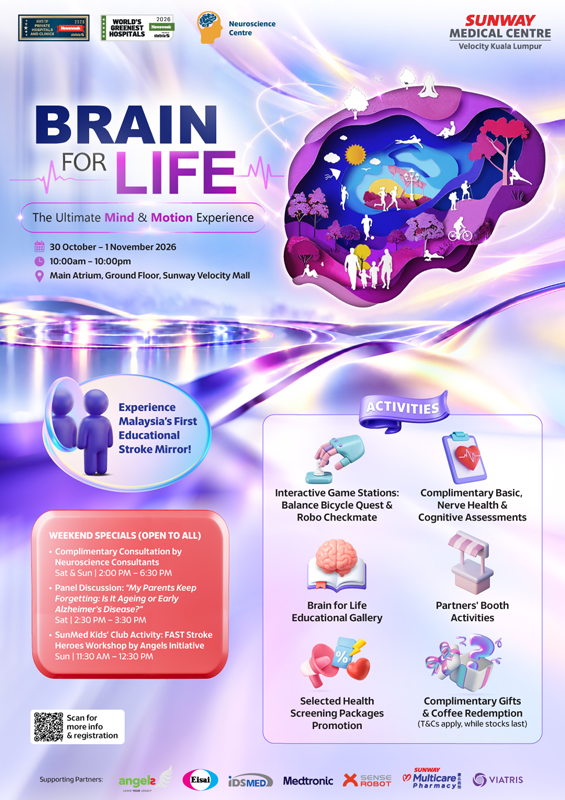
Public people who are looking to learn more can drop by SMCV’s neuroscience public event, Brain for Life: The Ultimate Mind & Motion Experience. With activities for all ages, it is a great opportunity for families to come together.
- Date: 30 October to 1 November 2026
- Time: 10AM to 10PM
- Venue: Main Atrium, Ground Floor, Sunway Velocity Mall
From stroke awareness to memory and brain health, the event covers neurological wellbeing across every stage of life. Highlights include SunMed Kids’ Club FAST Heroes Campaign by the Angels Initiative (A workshop for children to learn and identify stroke symptoms), interactive game stations, a panel discussion on memory loss and early Alzheimer’s disease, complimentary consultations with SMCV’s neuroscience consultants, complimentary health assessments, and promotion on selected health screening packages.
Visitors can also experience Malaysia’s first educational Stroke Mirror. While not a diagnostic tool, it shows a simulated representation of stroke-related symptoms, helping families learn one of the most recognisable warning signs together. Learn more about the event HERE.
Sunway Medical Centre Velocity is located at Lingkaran SV, Sunway Velocity. For enquiries, please contact +603 9772 9191 or email smcv-enquiry@sunway.com.my. For more information or to learn more about Sunway Medical Centre Velocity, visit www.sunwaymedicalvelocity.com.my (Facebook: Sunway Medical Centre Velocity).
[1] https://www.moh.gov.my/images/04-penerbitan/penerbitan-klinikal/perkhidmatan-OG-dan-pediatrik/pediatrik/FA_-_Paediatric_Protocols_5th_Edition_MOH_PDF_1-compressed.pdf
[2] https://www.moh.gov.my/images/04-penerbitan/penerbitan-klinikal/perkhidmatan-OG-dan-pediatrik/pediatrik/FA_-_Paediatric_Protocols_5th_Edition_MOH_PDF_1-compressed.pdf
[3] https://www.sciencedirect.com/science/article/abs/pii/S0387760425000208
 Dr Tan Jen Ern,
Consultant Paediatrician and Paediatric Neurologist,
Sunway Medical Centre Velocity (SMCV).
