

By Soo Sek Yow, Head of Soya Nutrition Unit, HOMESOY
In Malaysia, soya has long been part of everyday life. Whether it’s a warm bowl of tau foo fah after dinner, fresh soya milk from the neighbourhood stall, or a chilled carton enjoyed on a hot afternoon, generations of Malaysians have grown up with soya as a familiar source of nourishment.
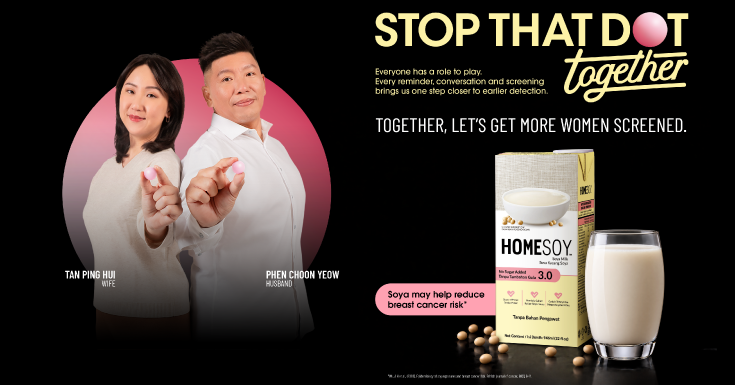
Main image: Stop That Dot Together Campaign
Yet despite this long history, soya continues to be surrounded by misconceptions, especially when it comes to women’s health in particular, breast cancer. Breast Cancer Awareness Month encourages us to prioritise early detection, screening and education, it’s also an opportunity to challenge the misinformation that can influence everyday health decisions.

The good news is that soya is one of the most extensively studied foods in nutrition science. More than three decades of research has helped scientists better understand how soya affects our health, and much of what we have learned contradicts the myths that continue to circulate today.
Myth 1: Soya causes breast cancer because it contains hormones.
This is perhaps the most common misconception surrounding soya, and one that has been debunked by science.
The confusion stems from isoflavones, naturally occurring compounds found in soya that are classified as phytoestrogens. While the name sounds like estrogen, phytoestrogens are plant-derived and do not behave like human estrogen in the body. Instead, they compete with our body’s estrogen and limit its activity, helping to reduce the risk of breast cancer.
Decades of extensive research have found no evidence that consuming soya causes breast cancer. In fact, observational studies consistently show that Asian women who consume more soya have a lower risk of developing breast cancer.
Myth 2: If you’ve had breast cancer, you should avoid soya.
Large-scale studies involving thousands of breast cancer survivors have found that consuming moderate amounts of soya foods is safe and associated with improved survival and a lower risk of recurrence (The American Journal of Clinical Nutrition).
Rather than avoiding soya out of fear, survivors can enjoy soya foods such as soya milk as part of a balanced, nutritious diet, with guidance from their healthcare team.
Myth 3: Pregnant women shouldn’t drink soya milk.
Pregnancy often comes with plenty of well-meaning advice, including avoiding soya due to the mistaken belief that soya isoflavones affect a baby’s development.
Fortunately, decades of research have shown otherwise. Clinical reviews and large population studies (Frontiers in Nutrition) consistently confirm that moderate soya consumption is indeed safe during pregnancy and does not negatively affect hormone levels or pregnancy outcomes.
Soya milk, especially fortified options like HOMESOY 3.0 Soya Milk, is a safe, nutritious way for expectant mothers to get high-quality protein and essential calcium for mom and baby. Like any wholesome food, moderation and balance remain key.
Myth 4: Soya causes gout.
Another persistent misconception is that soya products trigger gout because they contain purines.
However, research shows that plant-based purines do not increase serum uric acid levels or trigger gout flare-ups, unlike purines from red meat, organ meats or certain seafood. In fact, several large epidemiological studies have found that consuming soya foods is associated with a lower risk of gout, making it an ideal source of high-quality protein.
For many people looking to reduce their intake of animal protein, soya can be a nutritious alternative that supports a balanced, low-purine diet while providing high-quality protein.
Making Health Decisions Based on Science
Nutrition advice should be guided by evidence, not outdated myths or misinformation. Soya remains a nutrient-rich food that provides high-quality protein and other beneficial nutrients, making it a valuable part of a balanced Malaysian diet.
Understanding the science behind soya allows us to enjoy it with confidence and focus our attention on the health habits that truly make a difference.
HOMESOY continues its ‘Stop That Dot Together’ campaign to promote early detection of breast cancer and balanced nutrition. Partnering with the National Cancer Society Malaysia and over 40 medical centres nationwide including Sunway Medical Centre, Subang Jaya Medical Centre, Prince Court Medical Centre, and participating KPJ and Columbia Asia hospitals to reward proactive health choices. Women undergoing breast cancer screening at participating locations will receive a complimentary pack of HOMESOY 3.0 Soya Milk.
