

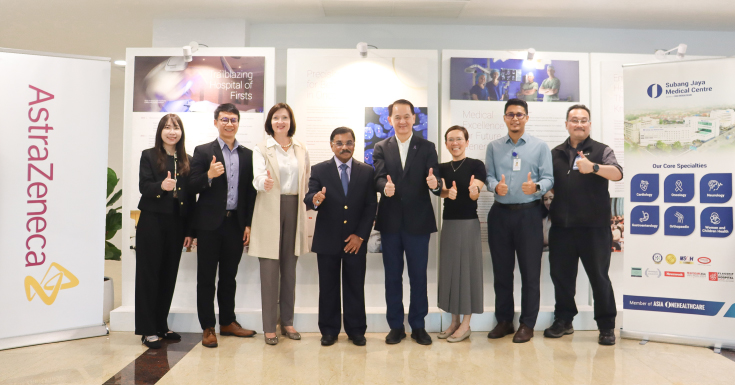
Subang Jaya Medical Centre (SJMC), in collaboration with AstraZeneca, introduced Malaysia’s first computational pathology solution that uses AI-assisted imaging to support the review of digitised tissue samples in breast cancer testing for patients in Malaysia. This represents a step forward in the digitisation of pathology services and the responsible integration of advanced technologies into routine clinical practice.
Main image: (From L to R) Noelle Cheah, Diagnostic Manager, AstraZeneca Malaysia; Chong Kah Wai, Head of Diagnostic Malaysia and Asia Diagnostic Lead, AstraZeneca Malaysia; Dr Svetlana Yanchuk, Country President, AstraZeneca Malaysia; Prof. Dr Pathmanathan Rajadurai, Consultant Pathologist, Subang Jaya Medical Centre; Bryan Lin Boon Diann, Regional Chief Executive Officer, Asia OneHealthcare & Chief Executive Officer, Subang Jaya Medical Centre; Rachel Woo, Chief Operating Officer, Subang Jaya Medical Centre; Mohammad Muslim Mohammad Effendi, Assistant Manager, Pathology, Subang Jaya Medical Centre; Jason Ang Soo Chieng, Manager, Laboratory, Subang Jaya Medical Centre.
This rising burden highlights the need for accurate and consistent diagnosis. 1 With emerging therapies for breast cancer with low and ultralow Human Epidermal Growth Factor Receptor 2 (HER2) levels, accurate and consistent HER2 testing is becoming increasingly important for patients in Malaysia.1 This test helps doctors understand how much HER2 is present in a cancer sample and supports treatment decisions. 1 Interpreting the results can be challenging, as small differences in how the sample appears under the microscope may affect how consistently it is scored.1
This collaboration supports the integration of digital pathology with AI-assisted analysis, helping pathologists assess HER2 in breast cancer through digitally scanned tissue samples. Using Mindpeak HER2 AI software, the tool is intended to support consistency and reliability in pathology reporting while remaining part of established diagnostic pathways and professional clinical judgement.
SJMC pathologists collaborated on multinational observational studies conducted with a technology partner to validate the AI-assisted solution. The implementation builds upon SJMC’s digital pathology workflow, where pathology slides are routinely digitised using whole slide imaging technology. The computational pathology solution integrates into this digital workflow, allowing AI-assisted assessment while ensuring that all final interpretations remain under the supervision and professional judgement of qualified pathologists.
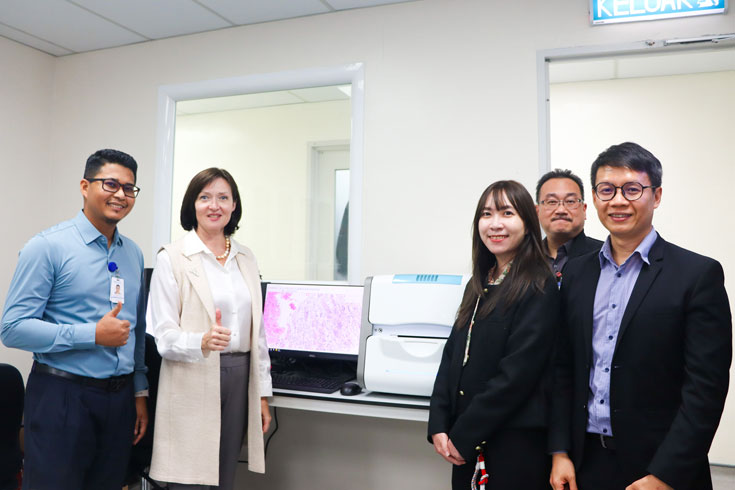
Scientific evidence highlights the potential value of AI-assisted pathology. An international study involving pathologists demonstrated that AI-assisted scoring of digital breast cancer cases assessed for HER2 increased agreement2 with reference scores while significantly reducing misclassification between HER2 ultralow and HER2 null3. Published research has also suggested that AI-assisted computational pathology may help improve agreement and consistency among pathologists.4,5
Beyond supporting more consistent assessment, the computational pathology approach using AI-assisted workflows may also support broader laboratory digitisation efforts and day-to-day workflow in pathology services.6 This may help pathology teams manage increasing case volumes while maintaining quality standards,6 and timely availability of diagnostic results may support treatment planning within standard clinical care pathways.6
Bryan Lin, Regional Chief Executive Officer of Asia OneHealthcare and Chief Executive Officer of SJMC, said, “This collaboration with AstraZeneca reflects SJMC’s commitment to advancing precision medicine and strengthening healthcare delivery through technology. By adopting new technology and contributing our pathologist’s clinical expertise and data to support the validation of this solution, SJMC, as the first hospital in Malaysia to introduce this computational pathology solution, continues to invest in innovations that support the advancement of our laboratory services in pathology and diagnostics, benefiting clinicians and patients with trusted diagnostic insights.”
“Although computational pathology has been widely discussed, adoption in day-to-day clinical diagnostics remains challenging across many healthcare systems.6 This collaboration reflects a shared commitment to move beyond theoretical discussions and support the responsible real-world implementation of technology that complements clinical expertise and can strengthen diagnostic confidence,” said Dr Svetlana Yanchuk, Country President, AstraZeneca Malaysia.
“Building on this collaboration, the initiative reflects AstraZeneca’s role in supporting the advancement of emerging technologies in biomarkers and precision diagnostics. By working with healthcare institutions such as SJMC and technology partners, we contribute scientific insights and global research experience to help enable the evidence-based adoption of innovation across healthcare systems,” she added.
The introduction of the computational pathology solution demonstrates how collaboration between healthcare providers, industry and technology partners can support the measured adoption of digital innovation in clinical diagnostics. SJMC and AstraZeneca remain focused on public education, scientific evidence and alignment with established clinical standards as computational pathology continues to evolve in Malaysia.
References
- Quantification of HER2 – low and ultra-low expression in breast cancer specimens by quantitative IHC and artificial intelligence
- Fully Automated Artificial Intelligence Solution for Human Epidermal Growth Factor Receptor 2 Immunohistochemistry Scoring in Breast Cancer: A Multireader Study Fully Automated Artificial Intelligence Solution for Human Epidermal Growth Factor Receptor 2 Immunohistochemistry Scoring in Breast Cancer: A Multireader Study | JCO Precision Oncology
- AI-enhanced precision: boosting pathologist confidence in HER2 ultra-low diagnosis through intelligent re-screening AI-enhanced precision: boosting pathologist confidence in HER2 ultra-low diagnosis through intelligent re-screening | Breast Cancer Research | Springer Nature Link
- Fully Automated Artificial Intelligence Solution for Human Epidermal Growth Factor Receptor 2 Immunohistochemistry Scoring in Breast Cancer: A Multireader Study 24.00353 1..10
- Precision HER2: a comprehensive AI system for accurate and consistent evaluation of HER2 expression in invasive breast Cancer pdf
- Computational pathology in cancer diagnosis, prognosis, and prediction– present day and prospects Computational pathology in cancer diagnosis, prognosis and prediction – present day and prospects.
