

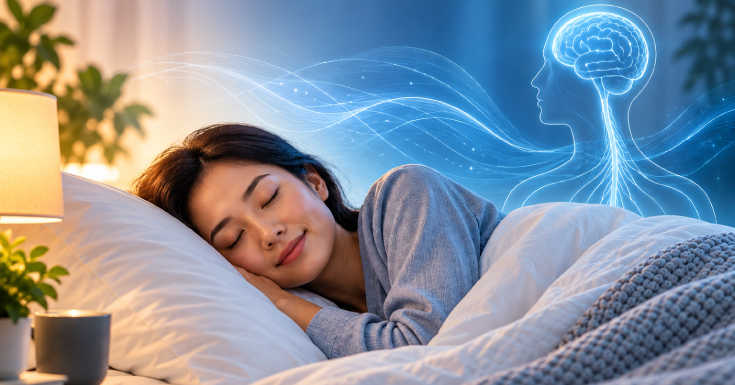
We have all heard the standard prescription for a restless night: turn off your screen, sip warm chamomile tea, and let your mind unwind. Yet for millions who lie awake with racing thoughts and tight shoulders, standard sleep hygiene falls frustratingly short.
The reason for this failure is simple: traditional advice focuses almost entirely on mental relaxation. It treats sleep as a top-down process, operating under the assumption that if you quiet your thoughts, your body will follow. But the nervous system is a two-way street. Physical stress, joint inflammation, and unmanaged muscle tension send persistent threat signals back up to the brain. When your body feels compromised, your brain’s alarm system simply refuses to let you sleep.
Breaking the Invisible Pain-Sleep Loop
Pain and sleep share a harsh, cyclical relationship. Nociceptive signals—the physical pathways that process pain—keep the central nervous system in a state of high alert. This triggers micro-arousals throughout the night, fragmenting your sleep and stripping away the restorative slow-wave and REM stages.
The damage does not end when the sun comes up. Sleep deprivation actively weakens your body’s descending inhibitory pathways—the natural internal mechanisms that dampen pain signals. Lacking deep sleep, your pain threshold drops, leaving you far more sensitive to discomfort the next day. You cannot simply meditate away a pinched nerve or an inflamed joint; breaking this cycle requires addressing the mechanical source through soft-tissue decompression and targeted spinal positioning before you lie down.
The Physiology of Autonomic Down-Regulation
Falling asleep requires your nervous system to shift from sympathetic dominance—the classic “fight-or-flight” response—to parasympathetic dominance, often called “rest-and-digest”. High sympathetic tone keeps your heart rate elevated, raises core body temperature, and causes involuntary muscle stiffness known as somatic muscle guarding.
When your muscles remain locked in defense, they send continuous feedback to the brain that the environment is unsafe. This is where physical therapy provides a crucial “bottom-up” key. Rather than struggling to force your mind to relax, you can use targeted physical inputs to force your nervous system to down-regulate. Simple protocols like extended-exhalation breathwork mechanically stimulate the vagus nerve, rapidly lowering neural excitability and signaling to the brain that it is finally safe to rest.
Rehabilitating the Upper Airway
Somatic sleep barriers extend beyond joint pain and muscle tension. Conditions like obstructive sleep apnea and chronic snoring stem from a purely mechanical issue: upper airway collapsibility. During sleep, the tone in the pharyngeal dilator muscles naturally drops, leading to narrowed airways, sudden drops in oxygen, and abrupt nocturnal awakenings.
Because the upper airway is lined with skeletal muscle, it responds to targeted physical conditioning. Myofunctional therapy—re-educating the tongue and soft palate muscles—restores baseline muscle endurance overnight. When paired with respiratory muscle training and postural alignment, physical intervention keeps the airway open without relying solely on passive, uncomfortable apparatuses.
Dosing Exercise for Optimal Sleep Pressure
While physical movement is one of the most effective non-photic cues for entraining our internal circadian rhythms, it requires precise dosing. Physical exertion accelerates the accumulation of adenosine in the brain, building homeostatic sleep pressure throughout the day.
However, exercise acts as a double-edged sword. Vigorous workouts scheduled too late in the evening spike cortisol and elevate core body temperature right when the body needs to cool down for sleep onset. Structuring movement to match individual fatigue thresholds ensures you build the necessary physical sleep pressure to fall asleep quickly, without triggering neuroendocrine burnout or overnight hyper-arousal.
 Alif Azman Bin Zainal Azman,
Physiotherapist
